Two years of AI governance work produced a lot of dashboards. It produced far fewer brakes.
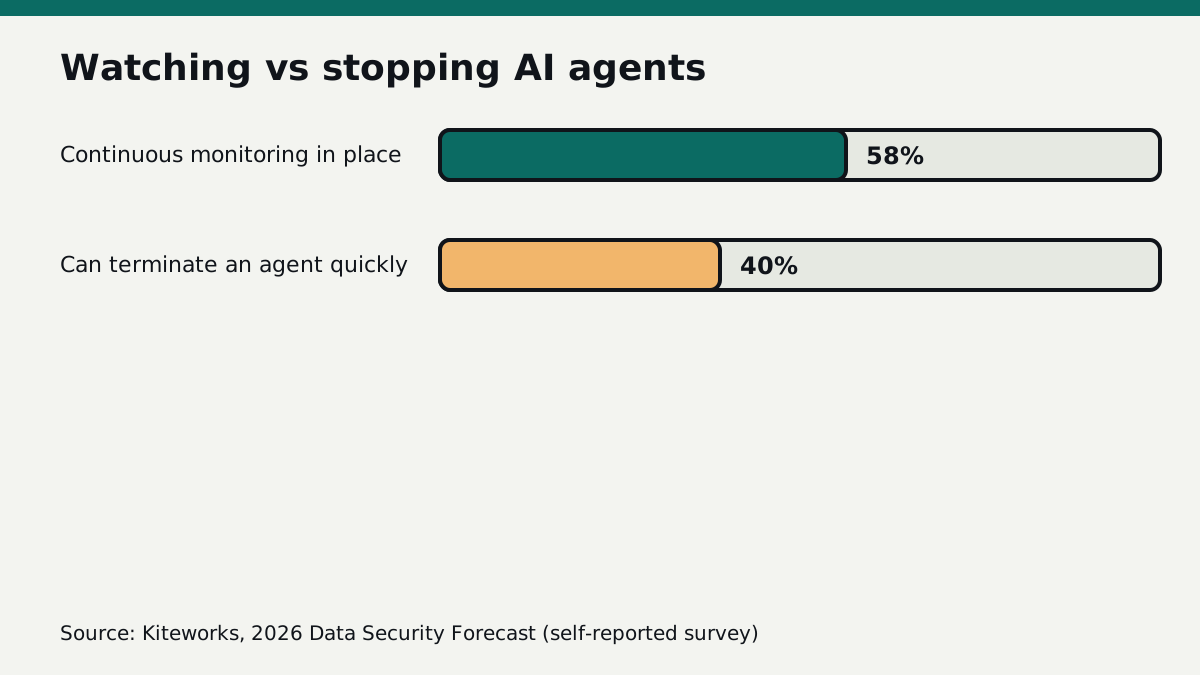
Kiteworks' 2026 forecast survey put numbers on it. Organizations reported continuous monitoring of AI systems (58%) and human-in-the-loop oversight (59%), yet 60% cannot terminate misbehaving agents quickly, 63% cannot enforce purpose limitations on agents and 55% cannot isolate AI systems from sensitive networks [1]. Kiteworks calls this the governance-containment gap. It is a self-reported vendor survey, but one of the few published measures of this gap.
Monitoring tells you something went wrong. Containment decides how much damage it does before you act. For a chatbot, the gap hardly matters. For an agent that can move money, change code or email customers, minutes matter, and "we would see it in the logs tomorrow" is not a control.
The security community moved the same way. OWASP published a separate Top 10 for Agentic Applications for 2026, focused on what agents do rather than what models say. And the EU AI Act's Article 14 on human oversight expects high-risk systems to let a person intervene or interrupt the system with a stop button or a similar procedure.
The test is simple and few teams have run it: pick an agent, pretend it is misbehaving, and time how long it takes to stop it, revoke its access and show what it did.
What to do about it
Run that drill. Then make the stop path a single, tested action per agent: one switch that halts it, one place to revoke its credentials, one log that shows its last actions. Our Govern service puts tested stop controls, audit trails and scoped credentials around your agents. See Govern.