If 2024 gave agents their plumbing, 2025 gave them their marketing. Almost every software product announced an "agent", and almost every company started a pilot.
The plumbing was real. Tool protocols spread quickly; by the end of the year Anthropic counted more than 10,000 active public MCP servers. Agents could now reach real systems. Whether they should, and whether they paid for themselves, was a different matter.
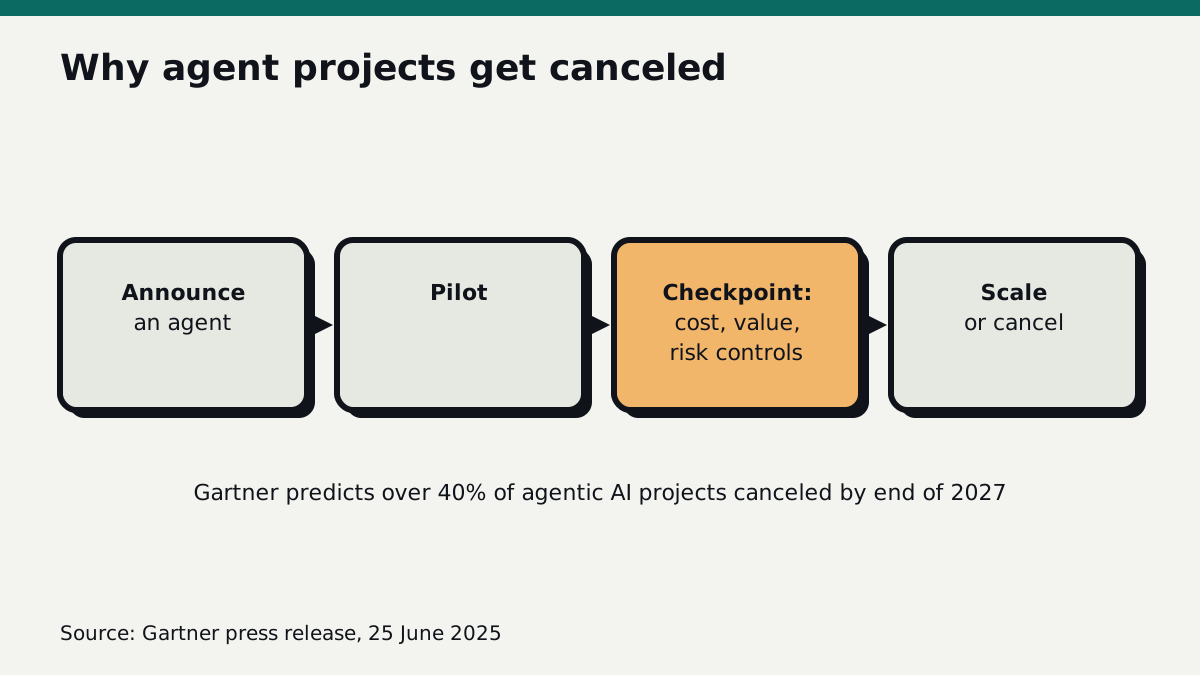
In June, Gartner predicted that over 40% of agentic AI projects will be canceled by the end of 2027, citing escalating costs, unclear business value and inadequate risk controls, and warned about "agent washing": existing chatbots and automation rebranded as agents [1].
Even the productivity case turned out to be harder to measure than expected. A randomised study by METR found that experienced open-source developers took 19% longer on real tasks when allowed to use AI tools, while believing they had been sped up. METR has since marked those early-2025 results as out of date, which is the point: claims about agents age quickly and need re-measuring.
The pattern that held up was narrower. Agents did well on well-bounded jobs with clear inputs, cheap mistakes and a human who checked the result. They struggled where the job was vague, the data was messy, or nobody could say what "done" looked like.
What to do about it
Before the next pilot, write down three things: the task and its owner, what a wrong action costs, and how you will measure value against today's process. Kill the pilots that cannot answer. Our Assess service maps the agents you run, what they can reach, and where the risk sits. See Assess.